It’s not news that the U.S. has entered a phase of deep social and political polarization. We continue to argue about topical issues that range Presidential ballrooms, and Bad Bunny v Kid Rock, to tariffs, Iran, and immigration, but, I fear, we are not addressing the key underlying causes. This is about one such cause.
If you have been keeping abreast of recent economic data and analysis, you may have come across the term— “K-shaped” economy. This descriptor appears to have its origins in the early 2000s and the initial impact of 1980s Reagan-era deregulation and economic reorganization.
In essence, the arm of the K (the upper diagonal) signifies the increasing economic wealth and consumption concentrated amongst the wealthiest Americans, while the leg of the K (the lower diagonal) signifies the decreasing economic wealth and consumption concentrated amongst the less wealthy.
(Interestingly, where the three lines intersect is called the “crotch”—reflecting where most of us get kicked on our path to lower wealth and consumption.)
The top 1% of our households now account for 32% of total net worth. According to the Gini Coefficient, which measures relative wealth inequality, we have reached 42 which is a 60-year high in the gap. In addition, current data shows the top 20% of Americans by income make up about 60% of consumer spending. Et voila. Welcome to the K-shaped economy.
So, when headline numbers about national GDP or unemployment or real income growth are presented, they often mask the problem. And one already disproportionately felt by minority communities. Real income is up this quarter! GDP is solid this month! Travel spending is up! These gains are likely being enjoyed by the top quintile in the country. For those of us in the other four quintiles, we are in an “affordability crisis.”
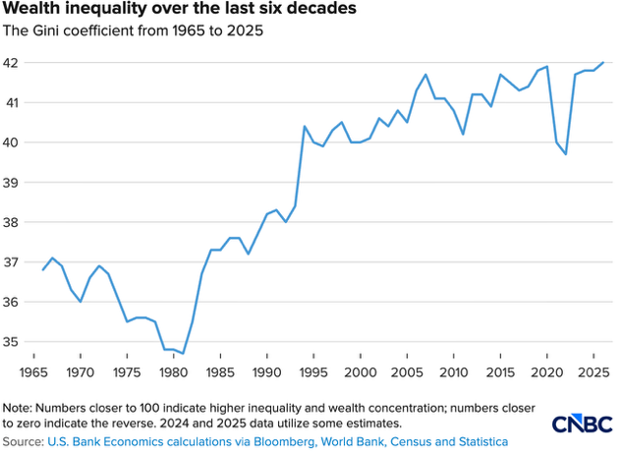
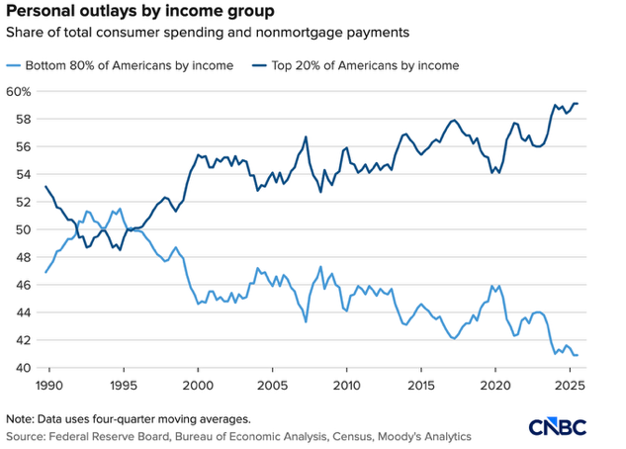
The implications of a K-shaped economy can be profound. History has shown that over time societies don’t tolerate this sort of grand wealth divergence very well. In fact, the historical outcomes of this wealth difference are already manifesting: increasing social and cultural inequalities, declining trust in government and institutions, regulatory capture by the wealthy and elite, eroding civic participation and civil behaviors, and…higher polarization. Generally, the resolutions of these outcomes have ranged from major policy reform (USA 1900s and 1940s) to revolution and civil war (France, 1790s; Russia 1920s) to state collapse (Roman Empire).
Without an aligned vision and concerted policy effort from political leaders, this trend will continue, with meaningful mid- to long-term implications for communities and for nonprofits, particularly 501(c)(3) organizations. First, recognize this is a secular trend. Demand for services continues to grow for the foreseeable future as economic pressures widen. Second, donor concentration will likely intensify as more households face tighter discretionary budgets. And, third, government funding may remain unpredictable as public budgets respond to economic pressure and shifting political priorities.
As we (implore and) wait for policy makers to address these underlying issues, nonprofits should be focusing on building the foundations and systems for sustainability. Strong partnerships and collaborations, diversified revenue streams, distinctive positioning and assets, and broader reach help create the stability and visibility organizations are going to need to sustain their missions.
To dig deeper into the topic, organizations such as The Urban Institute, Brookings, or the Economic Policy Institute - along with Minneapolis resources such as Minnesota Economics Big Data Institute (MEBDI) - research, promote understanding and advocate on this issue.
Let me know what you think! Mike
mike@depauw-co.com