"I'll follow him around the Horn, and around the Norway maelstrom, and around perdition's flames before I give him up."
— Captain Ahab, Moby-Dick by Herman Melville
Captain Ahab's pursuit of the white whale has become one of literature's great metaphors for determination. It is also one of its great warnings. The novel reminds us of what can happen when determination becomes an obsession, or when we try to control something that is ultimately outside our control.
It also is a cautionary tale for nonprofit donor marketing and fundraising.
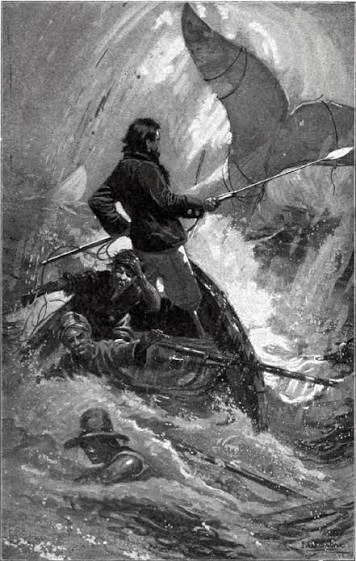
Ahab in his final chase with Moby Dick, I.W. Taber
Not long ago, I was with a nonprofit leadership team as they celebrated submitting five grant applications during the first half of the year. One received funding. It was a genuine success, and the team had every reason to celebrate.
As the meeting continued, attention shifted naturally to the next grant, the next appeal, and the next campaign. No one asked why the organization's donor base had remained essentially unchanged for the past two years. No one asked whether enough new people knew the organization or had been invited to support it.
This isn't an argument against grants, stewardship, or donor retention. Each one of those activities matters. But somewhere along the way, many organizations have become so committed, perhaps even addicted, to relying on donor retention and chasing “the whale” that we've stopped asking whether it is the best strategy for growth.
Are the number of people who know us and give to us growing?
Research tells a consistent story about the balance between acquisition and retention. More importantly, it challenges one of the assumptions on which many organizational growth strategies are built: that sustainable growth comes primarily from donor loyalty - retaining and extracting greater value from the people who already know us.
Consider just a few findings about donor "loyalty":
· The average donor supports four to five nonprofit organizations each year. ¹
· More than 70% of supporters are shared across nonprofits rather than belonging exclusively to one organization. ²
· Only 37% of heavy donors remain so the following year, and within two years most have moved into a different giving pattern. ³
· About 37% of people who intend to give never follow through, while roughly 50% of those who do not intend to give end up giving anyway. ⁴
People support multiple causes. Their priorities change. Their financial circumstances change. Sometimes they simply forget. None of this reflects a lack of generosity or commitment. It's simply how people behave. Succeeding in an environment shaped by this donor behavior is more an act of fortunate heroism by the executive director or development director than the result of a system designed for sustainable growth.
Sustainable growth requires more than stewarding the people who already support us. It requires continually introducing new people to the organization. Consider two additional findings:
· People are 14 times more likely to be unaware of a nonprofit than to actively reject it. ⁵
· More than 70% of people rejected no charities at all, suggesting the greatest barrier is awareness rather than opposition. ⁵
One way to think about addressing this challenge comes from marketing researchers Les Binet and Peter Field. Drawing on decades of evidence, they argue that organizations seeking sustainable growth should devote roughly 60% of their effort to building future demand and 40% to converting demand today. ⁶
For nonprofits, that means prioritizing organizational time, resources, and effort toward building recognition, reaching new audiences, and introducing more people to the mission, while the balance focuses on stewardship, fundraising, grant writing, renewal campaigns, and converting existing donors into ongoing support.
The Binet and Field principle is worth considering because we've become exceptionally comfortable stewarding the supporters we already have and far less intentional about growing the number of people who know us.
Perhaps stewardship feels productive because we can more easily measure it, track it, and report on it. Building awareness, salience, and donor penetration take longer and are harder to attribute, but they ultimately determine the size of tomorrow's community of supporters. Whatever the reason, growth through retention has become a central focus for many nonprofit organizations.
Which brings us back to Ahab.
Ahab's tragedy was not in whaling. It was his refusal to change the course of his maniacal pursuit of the White Whale despite every warning around him.
The evidence about nonprofit growth is clear. The question is whether we're willing to let it guide our course.
References
1. Giving USA Foundation. (2023). Giving USA 2023: The Annual Report on Philanthropy for the Year 2022.
2. Faulkner, M., Romaniuk, J., & Stern, P. (2022). How sharing of supporters reveals competition amongst non-profit brands. Journal of Marketing Management.
3. Faulkner, M., Romaniuk, )., & Stern, P. (2016). New versus frequent donors: Exploring the behaviour of the most desirable donors. Australasian Marketing Journal, 240).
4. Nguyen, C., Faulkner, M., Yang, S., Williams, J., & Tong, L. (2022). Mind the Gap: Understanding the Gap Between Intentions and Behaviour in the Charity Context.Journal of Business Research.
5. Faulkner, M., Romaniuk, J., & Truong, V. (2016). Barriers to Increasing Donor Support: Evidence on the Incidence and Nature of Brand Rejection.Nonprofit and Voluntary Sector Quarterly.
6. Binet, L., & Field, P. (2013). The Long and the Short of It: Balancing Short and Long-Term Marketing Strategies. London: Institute of Practitioners in Advertising (IPA).