When looking good gets in the way of doing good
In 1847, Ignaz Semmelweis noticed something disturbing at Vienna General Hospital. Women giving birth in the physicians’ clinic were dying from childbed fever at far higher rates than those cared for by midwives.
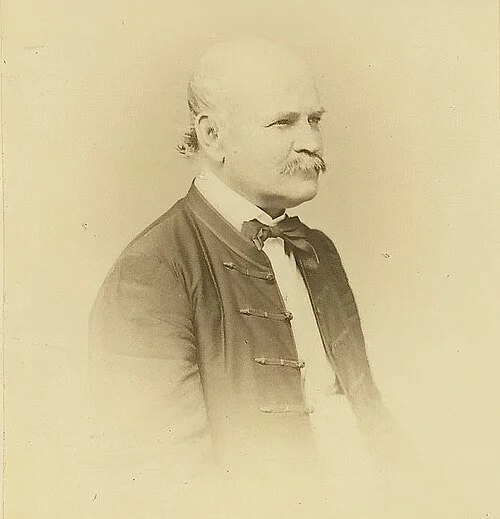
Dr. Ignaz Semmelweis
He suspected the doctors themselves. Physicians routinely moved from autopsies to maternity patients without washing their hands. Semmelweis required handwashing with chlorinated lime, and maternal mortality plummeted.
The medical establishment, however, didn’t embrace him. Semmelweis wasn’t simply challenging a medical practice; he was challenging accepted standards of care. Consequently, his ideas were attacked and dismissed, he lost his position in Vienna, and years of professional rejection followed. Semmelweis died at 47, without living to see hand hygiene become accepted medical practice.
His story is often told as a cautionary tale about resistance to new ideas. But there is another more subtle lesson: standards and conventions can become so embedded that simply following them becomes its own evidence of doing things well. (When that happens, new evidence is no longer judged on its merits; it is judged by how much it challenges the accepted standard.)
NONPROFITS DOING GOOD OR LOOKING GOOD?
In the nonprofit community, we follow accepted practice because it represents what a responsible professional or organization is supposed to do. Over time, conformity itself becomes proof that we are doing things well. So, we all do them. The nonprofit term is isomorphism.
Accepted financial conventions and metrics are well-known. Keep overhead low. Minimize fundraising costs. Diversify revenue. Maintain a lean financial position. Avoid debt. Put as much money as possible directly toward programs. They sound like the traits of a responsible nonprofit. But are they evidence of good stewardship or simply the conventions we have come to associate with it?
That is the question behind George Mitchell and Thad Calabrese’s research, The Hidden Cost of Trustworthiness. They describe these behaviors as “fiscal probity signals,” observable financial practices that communicate responsible stewardship because actual mission performance is much harder to evaluate.
Conventional expectations around overhead, diversification, reserves, operating margins and debt have become deeply embedded in ideas about what a financially responsible nonprofit should look like. The researchers note that these norms are reinforced through rating systems, funding criteria, textbooks, and benchmarking, even though systematic empirical evidence that conformity improves mission performance has been largely absent.
What happens when evidence challenges the convention?
WHAT HAPPENS WHEN NONPROFITS “BREAK THE RULES”?
Mitchell and Calabrese examined donative public charities using Form 990 data spanning 1982 to 2019. They compared organizations adhering to conventional financial norms with “norm-busting” organizations that departed from them.
An important distinction: the study doesn’t measure mission impact directly. It measures expenditures. Form 990 data don’t provide consistent measures of nonprofit outcomes or impact, so the authors use expenditure growth as an imperfect but reasonable proxy. Programs require resources and, all else equal, greater spending capacity provides greater potential to deliver the mission.
The numbers don’t tell us how much more impact an organization created. They tell us how much more or less it was able to spend toward its work over time.
Norm-busting behavior 10-year spending effect
Higher administrative expense. –12.88%
Higher fundraising expense +15.13%
Greater revenue concentration +17.36%
Greater reserves –9.50%
Higher operating margin +31.74%
Greater borrowing +11.33%
Combined effect +53.19%
Source: Mitchell & Calabrese, “The Hidden Cost of Trustworthiness,” Table 5. Total spending is used as a proxy for potential mission impact.
Higher administrative spending and greater reserves were associated with lower cumulative spending. But greater fundraising investment, revenue concentration, larger operating margins and greater use of debt were associated with greater spending capacity over time.
Spending less to raise a dollar makes an organization look efficient. But fundraising requires finding donors, building relationships, communicating and keeping people engaged. Cutting those investments may improve the ratio today while limiting resources tomorrow.
A surplus can look like money that wasn’t spent on the mission. Yet it can provide capital to hire people, invest in fundraising or technology, develop programs and build future capacity. Higher operating margins produced the largest positive individual effect: 31.74% greater cumulative spending over ten years.
Sometimes we need reminding that efficiency and growth are not the same thing.
PPRIORITIZE THE GOAL, NOT THE SIGNAL
For nonprofits, being trustworthy is non-negotiable. But being trustworthy and looking trustworthy are not the same thing.
Low overhead isn’t trust. A diversified revenue pie chart isn’t trust. Avoiding debt isn’t trust. Spending almost every dollar that comes in isn’t necessarily good stewardship. These are signals. And signals are useful until we start managing to them rather than to the outcomes they were intended to address.
Mitchell and Calabrese don’t suggest nonprofits abandon these conventions. But their research should encourage us to question them. Smart, responsible “norm-busting” deserves a place in the strategic discussion: where should we invest more, when might concentration outperform diversification, and when could a surplus or borrowing create greater capacity?
Semmelweis’s mistake wasn’t questioning the standard. It was doing so before the standard was ready to be questioned. Nearly two centuries later, perhaps the lesson is that accepted practices should never be exempt from evidence.
For nonprofits, the goal shouldn’t be to conform to conventions and signals that merely allow us to look good. But for us to make the right choices that allow us to do more good.
There’s much, much more in the research. I hope you’ll read it and let me know your thoughts.
Research
Mitchell, G. E., & Calabrese, T. D. (2023). The hidden cost of trustworthiness. Nonprofit and Voluntary Sector Quarterly, 52(2), 304–326. https://doi.org/10.1177/08997640221092794