I. Me. Mine.
What moves someone from caring about a cause to actually doing something about it?
A recent study in the British Journal of Social Psychology offers an interesting way to think about that question. Charlie Crimston and his colleagues conducted three studies involving 1,256 people, separating two judgments we might normally assume go together. The first was about rights: whether another person, animal or entity deserves moral care and protection. The second was about obligation: whether I believe I have some responsibility to provide that care or protection.
People were more willing to extend rights than accept obligations. Most interestingly for nonprofits, obligation was more consistently associated with intentions to donate, volunteer and engage in other prosocial behavior than simply recognizing rights.¹
Think about how much nonprofit communication is devoted to establishing that something matters. We explain the problem, demonstrate the need, tell someone's story and show the consequences. Children shouldn't go hungry. People experiencing homelessness deserve safe housing. Animals deserve humane treatment. Those are important beliefs, but they don't really answer another question: What does this have to do with me?
And yet, after making the case that someone deserves our concern, we often jump directly to the donate button.
But caring isn't the same as acting. Something has to connect the two. I've started thinking about it as:
Recognition — this cause is important.
Responsibility — you play a role in helping address it.
Agency — you can do something meaningful.
Action — doing it.
To me, it’s a simple framework to answer the practical question this research raises: Are we simply making people care, or are we creating the conditions that turn caring into action?
By itself, that is an important thought to take away from the research.
Then I thought more about the circles.
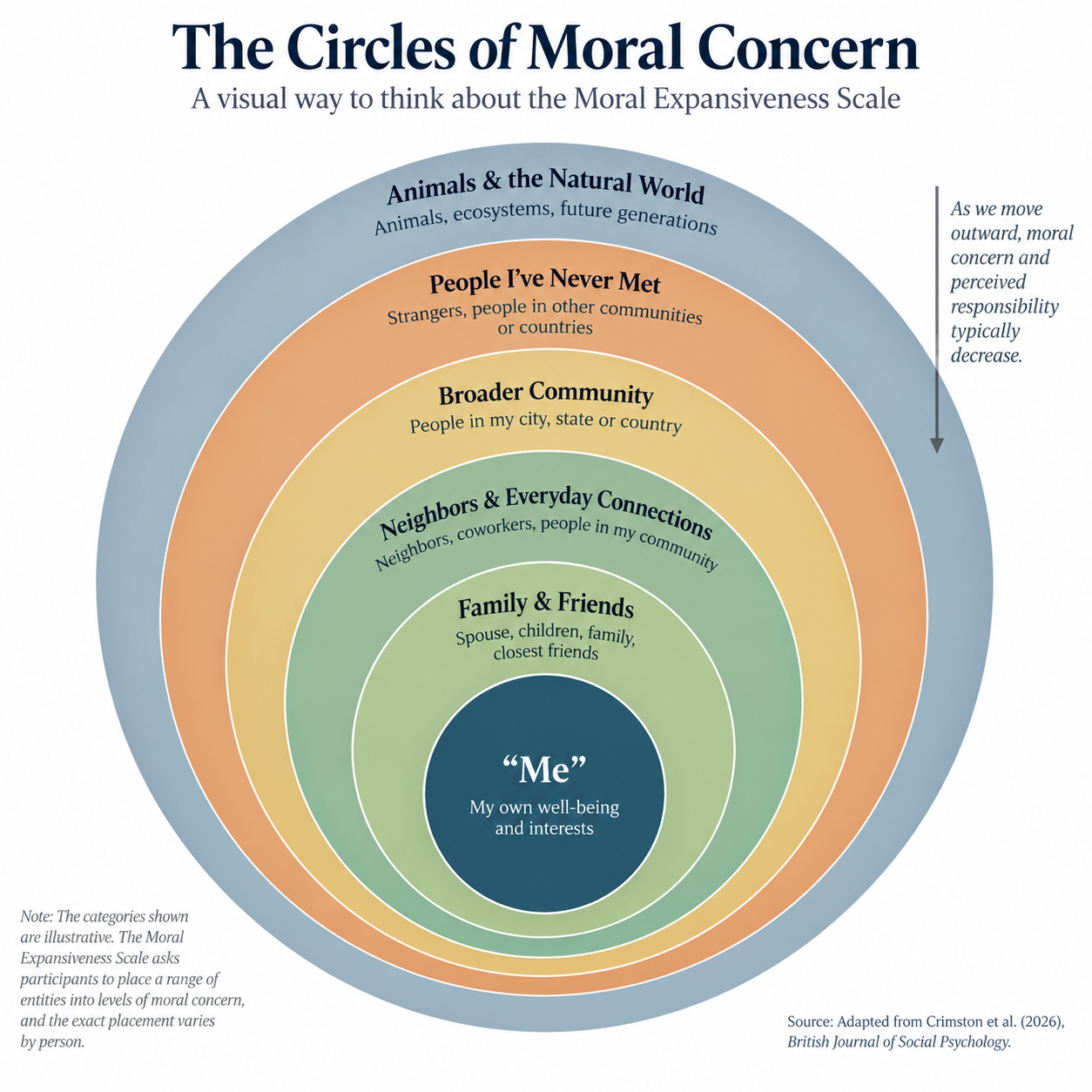
The researchers use something called the Moral Expansiveness Scale. Imagine a person at the center of a series of concentric circles. At the center is “Me.” Immediately around “Me” are those someone feels the greatest moral concern and responsibility such as a spouse, children, family and closest friends. Move outward and the circles begin to include neighbors, coworkers and people in the community. Farther still might be strangers, people in other communities or countries, and eventually animals and parts of the natural world.
Crimston and his colleagues ask us to think about those circles in two different ways: Who belongs inside my circle of moral concern? And who belongs inside my circle of moral obligation? Their research finds that the first tends to be larger. We are willing to say that many people and entities deserve care and protection while drawing a tighter boundary around those for whom we feel personally responsible.
A few questions occurred to me: have the size or intenstity of the circles changed over time? Are we becoming less oriented around “we” and more around “me”? Unfortunately, we don't have decades of Moral Expansiveness Scale data to answer that, so I started looking for other clues.
Jean Twenge and her colleagues analyzed pronoun use in 766,513 American books published between 1960 and 2008. Use of I and me increased 42%, while we and us declined 10%. The researchers interpreted the pattern as consistent with increasing individualism and decreasing collectivism in American culture.²
Books aren't people, and more use of I doesn't mean Americans became more self-centered. However, there are other clues that our circles may be changing:
We trust each other less. The share of Americans saying most people can be trusted fell from 46% in 1972 to 34% in 2023–24.³
We trust our neighbors less. Those saying they trust all or most people in their neighborhood fell from 52% about a decade ago to 44% today.³ Only about a quarter say they know all or most of their neighbors.⁴
We participate less in some traditional institutions. 57% of Americans now seldom or never attend religious services,⁵ while union membership has fallen from 20% in 1983 to 10% in 2025.⁶
Fewer households give. The share of American households donating to charity fell from roughly 66% around 2000 to 47% in 2020.⁷
Fewer people are giving more money. Americans gave a record $617 billion in 2025.⁸
Millions still volunteer. More than 75 million Americans volunteered through an organization in 2023,⁹ while 54% helped or exchanged favors with neighbors.⁹
But we're giving less time. Median annual volunteer hours fell from 40 in 2017 to 24 in 2023.⁹
I'm less interested in any one measure than in the pattern they begin to form. A church basement, union hall, neighborhood association, charitable organization or volunteer group creates relationships with people outside our immediate circles. Taken together, the direction is hard to ignore: our circles of participation may be getting tighter.
And that is a critical issue for many nonprofits because we depend on people being willing to care and act beyond their immediate circles. And if those circles are tightening, we need to continue to move beyond “our cause is important.” Most of us would agree that a child we've never met should have enough to eat, that someone across town deserves a fair chance at a job, or that a family on the other side of the world should have clean water. They all fit comfortably within our circle of concern.
The question for nonprofits is how we help people move from recognition to action.
Which brings me back to where I started. Recognition says this matters. Responsibility says I have a role. Agency says I can make a difference. Action is doing it.
That gives nonprofits a pretty practical path: Don't simply tell people why the cause matters. Show them why their participation matters, what it can accomplish and how they can help. Then make it easy to do so.
Because if “we” is getting smaller, nonprofits have an important role and obligation to help make it bigger.
Sources
1. Crimston, C. R., Rottman, J., Neldner, K., Wilks, M., & Young, T. (2026). “Deconstructing the moral circle: Obligations as the driver of moral expansion.” British Journal of Social Psychology, 65, e70073.
2. Twenge, J. M., Campbell, W. K., & Gentile, B. (2013). “Changes in Pronoun Use in American Books and the Rise of Individualism, 1960–2008.” Journal of Cross-Cultural Psychology, 44(3), 406–415. Journal article
3. Pew Research Center. (2025). “Americans’ Declining Trust in Each Other and Reasons Behind It.” Pew Research Center report
4. Pew Research Center. (2025). “How Connected Do Americans Feel to Their Neighbors?” Pew Research Center analysis
5. Gallup. (2026). “Americans’ Religious Engagement Holds at Lower Levels.” Gallup report
6. U.S. Bureau of Labor Statistics. (2026). “Union Members — 2025.” BLS report
7. Indiana University Lilly Family School of Philanthropy. (2024). “Drop in Share of Americans Who Give to Charity Accelerated in First Year of COVID-19, Even as Average Amount Given Rose.” Lilly Family School of Philanthropy research
8. Giving USA Foundation. (2026). Giving USA 2026: The Annual Report on Philanthropy for the Year 2025. Giving USA reports estimated U.S. charitable giving of $617.2 billion in 2025.
9. U.S. Census Bureau & AmeriCorps. (2024). “New U.S. Census Bureau and AmeriCorps Research Tracks Virtual Volunteering for First Time.”